Macy's On‑Call: putting AI in the store aisle
IBM had Watson, and it needed proof that AI could be useful in everyday life. I led design on Macy's On-Call: a shopping assistant on the customer's own phone that knew the store, the stock and the shopper, and knew when to bring in a person.
- The problem
- Watson had to prove AI could help in everyday life, while store staff feared it would replace them.
- My role
- Design lead on a cross-functional prototyping team: conversation design, the service blueprint and the associate handoff.
- Team
- Designers, researchers and Watson engineers I led, working with Macy's store teams.
- Outcome
- Shipped in weeks. One of IBM's four flagship Watson showcases at IBM Think 2016, cited by Ginni Rometty.
AI that helps people, instead of replacing them
Watson could process data at a scale nobody else could, but it had no human intuition. And the people it was meant to help, both shoppers and store staff, were afraid of it. Associates heard "AI" and assumed it meant "fewer associates".
Retail was the right test case because the stakes are everyday: can I find this, in my size, in this store, right now? If AI couldn't make that easier, it wasn't going to make anything easier.
We designed AI that improved decisions instead of erasing them.
The calls I made
Where should the assistant live?
A kiosk means walking to the kiosk. The phone is already in the shopper's hand, in the aisle where the question comes up.
What it cost: no app install, so every answer had to be fast and useful on a store's patchy connection.
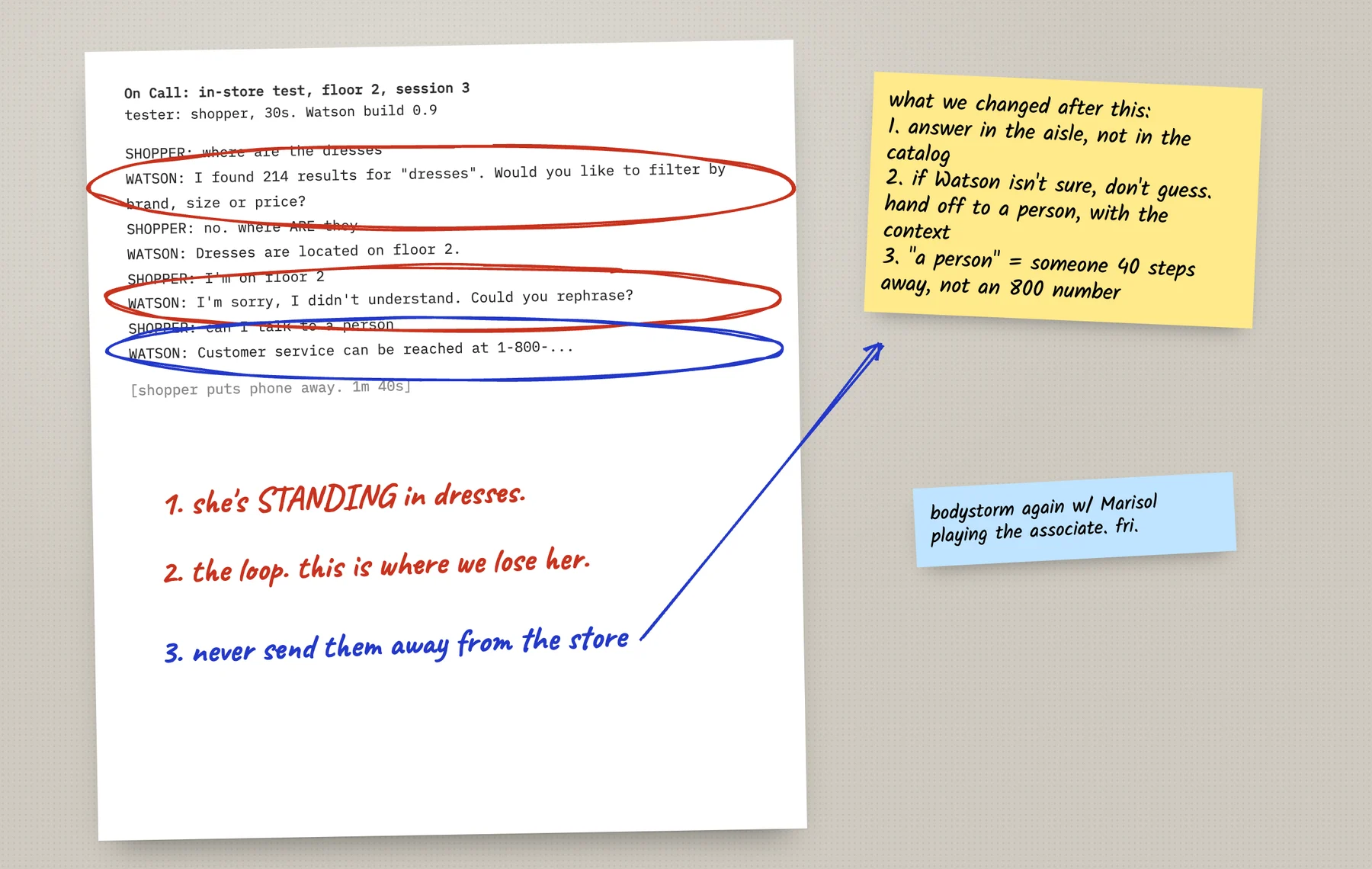
What happens when Watson isn't sure?
This made associates the hero of the hard moments instead of the casualty of the easy ones. It's also what got the store teams on our side.
What it cost: a second interface, the associate's handoff, built in the same weeks.
Designing the conversation, and its edges
The interface was a conversation, so the design work was mostly about structure: what Watson must know before it answers, which questions narrow things down fastest, and where the machine stops and a person takes over.
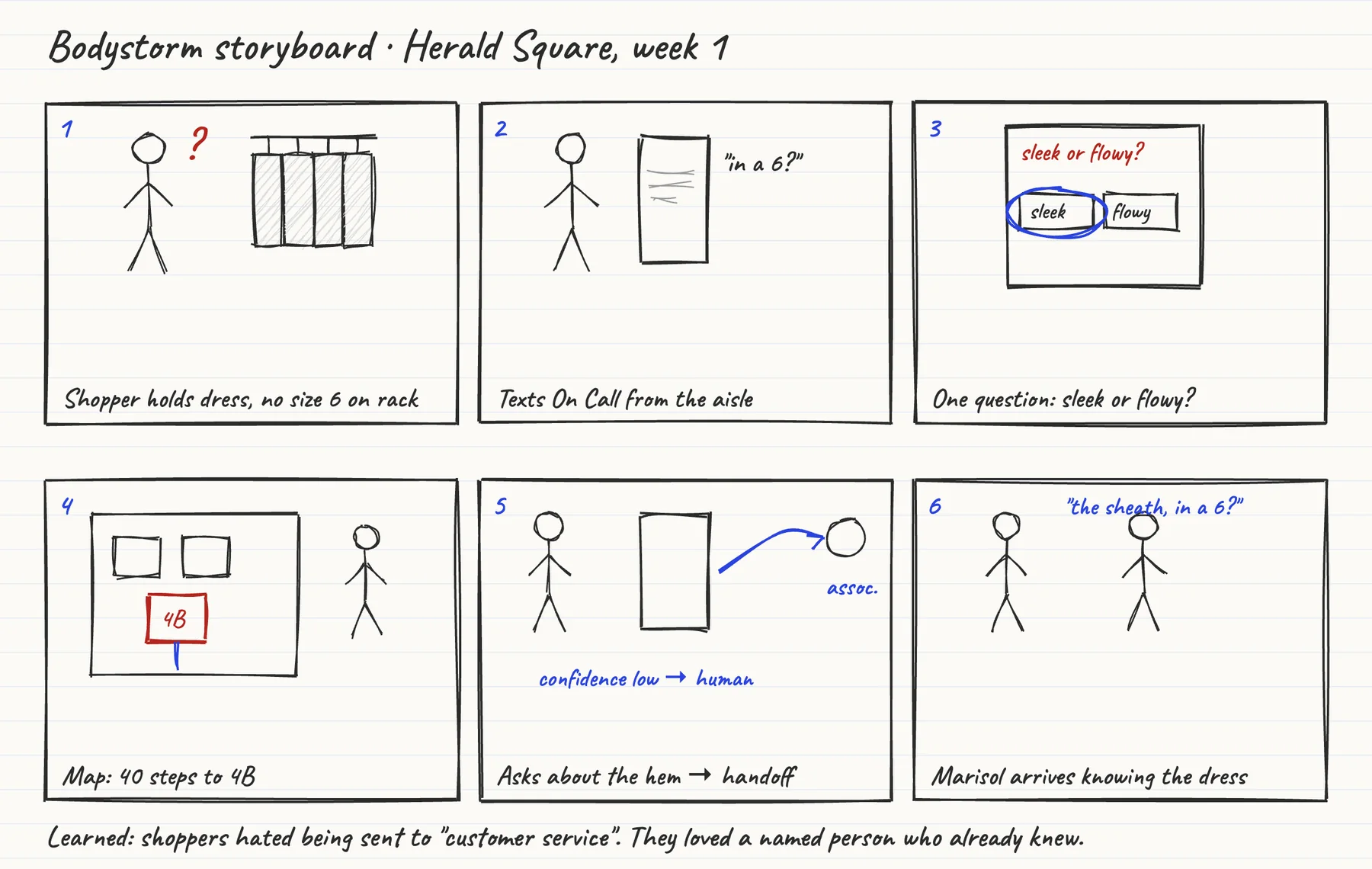
The first two screens follow the shipped conversation. The handoff screen is reconstructed.
What happened next
On-Call was built in weeks and became one of IBM's four flagship Watson showcases. It was presented at IBM's global conference as a top AI breakthrough and featured in IBM's annual shareholder report.
Absolutely! I found a few in your size. Do you prefer something sleek or more flowy?
Something sleek.
Got it! The Calvin Klein sheath dress is a bestseller. Want me to show you where to find it?

"Macy's On-Call, developed with Watson AI, allowed shoppers to get real-time information about store layouts, sales, and product availability through their smartphones"Ginni Rometty, then CEO of IBM
Highlighted in IBM's annual shareholder report.
Flagship innovations
IBM embraced design. It changed mine.
IBM wasn't always a design-first company. Ginni Rometty saw that design wasn't decoration, it was strategy. Watching that happen from inside taught me the lesson I still work by: building an intelligent system is the easy half. Making it practical, human and something people rely on every day is the job.