Ohm: a score for your life
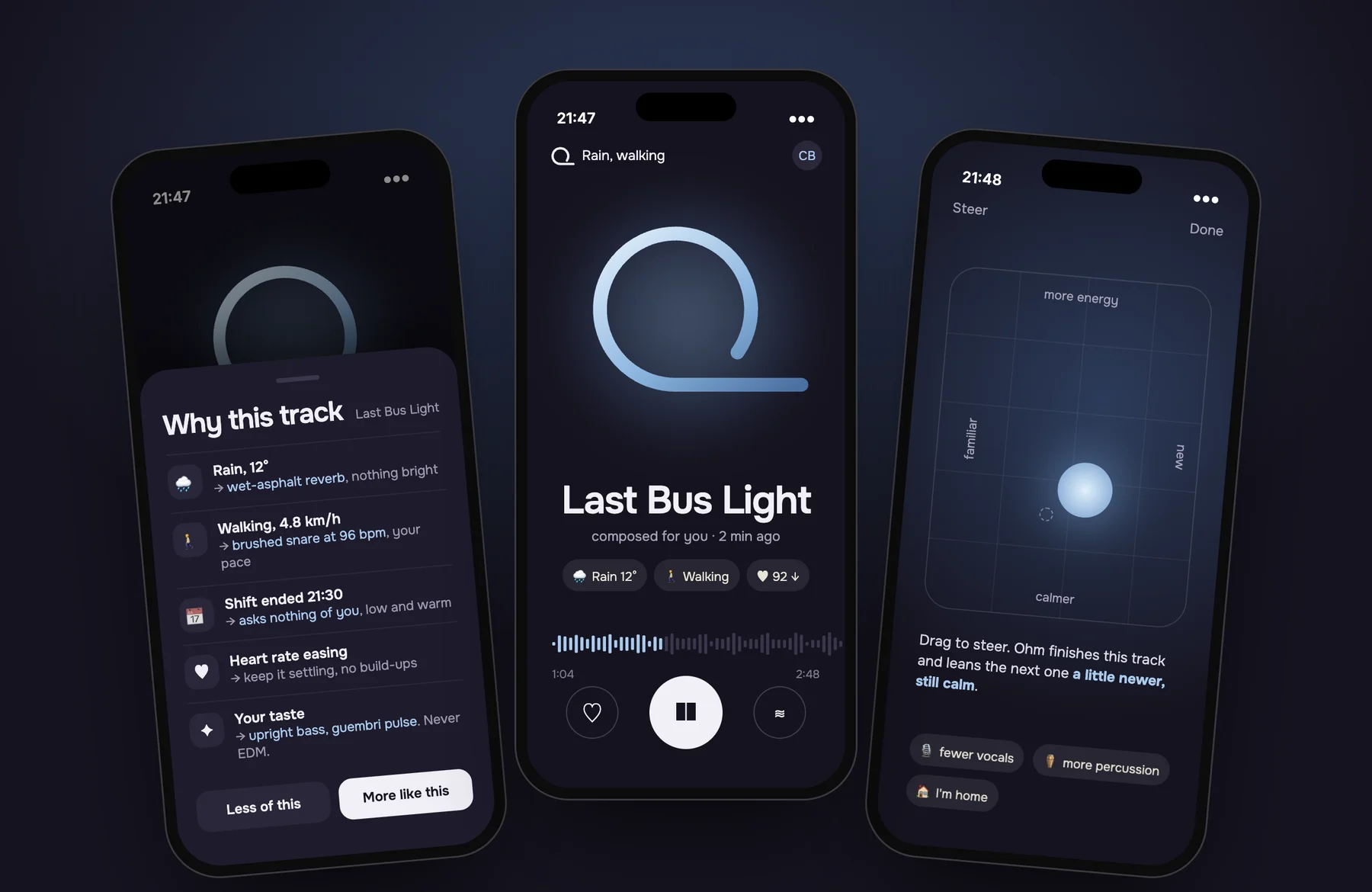
A song is never played the same way twice
This is the idea Ohm started from, back in 2016. A band never plays a song exactly like the record, and I wanted music in Ohm to work the same way. An artist publishes a song once, and Ohm performs it for each listener's moment.
The first demo shows Ohm knowing you. This is what that's for: the same melody, the same song, and a unique performance for the listener.
I designed and built Ohm solo. It began as a private beta on WhatsApp that composes a track for the moment you text it. The standalone app is designed from what that beta taught me.
- The problem
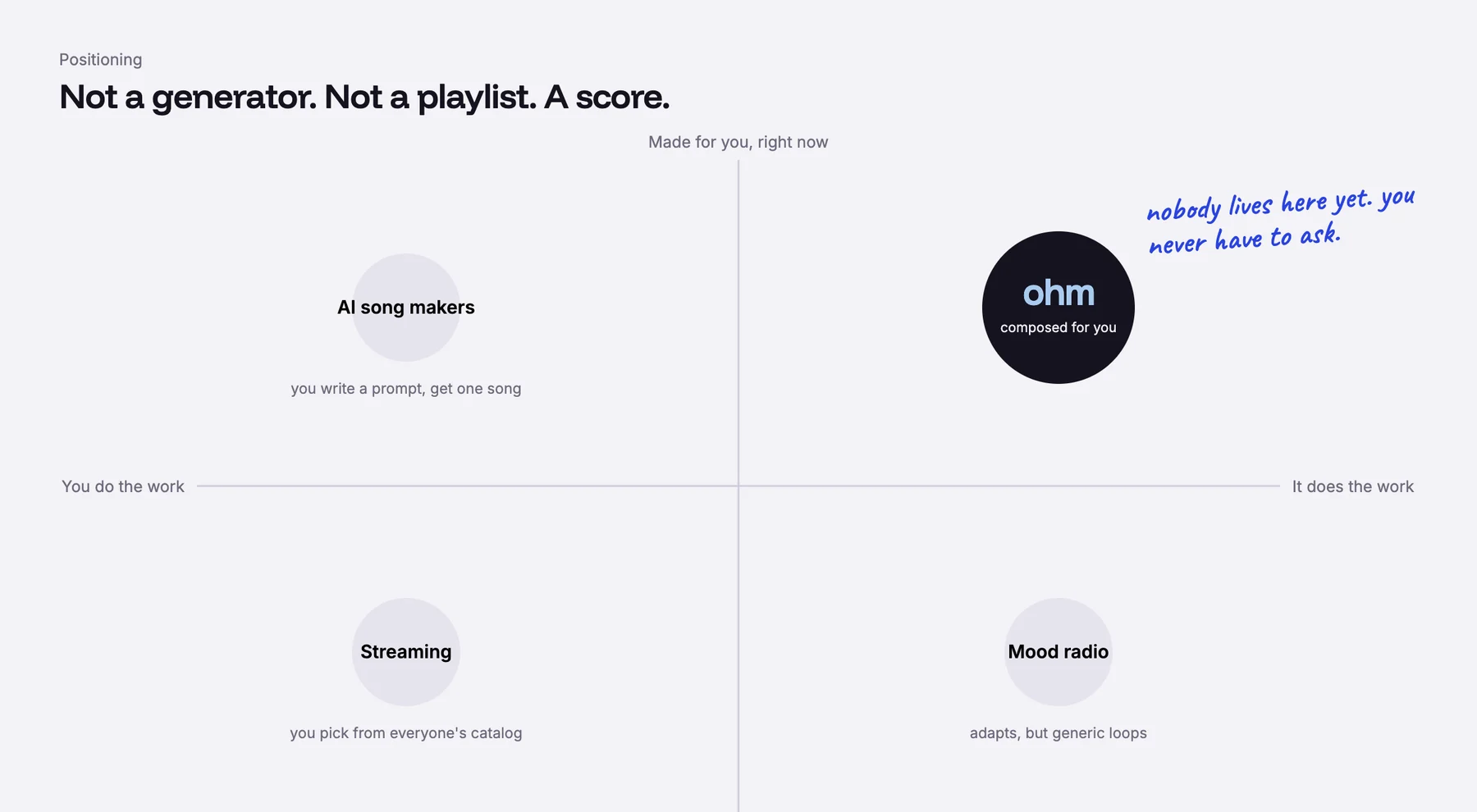
- Streaming gives you everyone's music, and AI song makers make you write a prompt for one song. Artists release a record that plays the same way forever. Nothing scores the life you're actually living.
- My role
- Founder. Product, conversation and prompt design, and the build, done solo with Claude Code.
- Team
- Me, with Claude Code as my engineering partner, and two beta listeners who told me everything.
- Outcome
- A working beta that composes and sends tracks, and the standalone app designed from its six biggest lessons.
The taste engine is the product
Everything you just heard was a decision, not a default. The music models are commodities and they'll keep changing. What makes Ohm sound like Ohm is the layer that decides what a moment should feel like, who plays it, and how much room to leave.
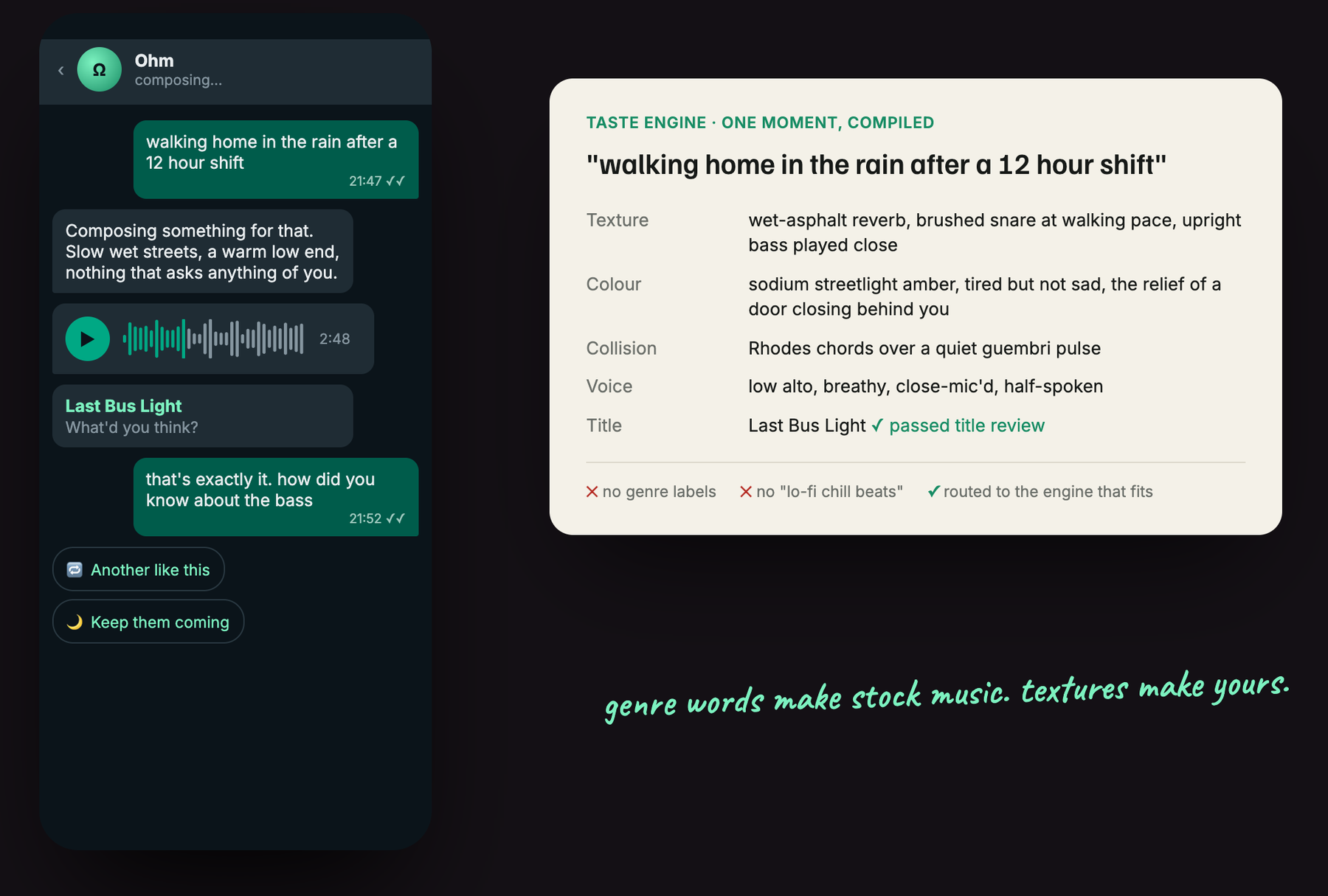
It writes in textures, never genres: "wet-asphalt reverb, nothing bright", not "lo-fi". It casts instruments and voices the way a director casts actors, and sends every title through a second review so nothing comes out pretentious. A router picks the model that fits each brief.
Today it writes the brief for every new track. Tomorrow it decides how an artist's song is performed for you. That's why it's the product.
The system, live. The seven rules, the reviews, the router, the sequencer and the motif are Ohm's real design. The moments and briefs are illustrative, taken from the first demo.
Not a generator. Not a playlist.
Every music product makes you do the work: search a catalog, or write a prompt and wait for one song. Ohm starts from the other end. It already knows it's raining, that you're walking and what you love, so it doesn't ask. It plays.
The calls I made
Should the home screen have a prompt box?
A prompt box turns listening back into work. The point of Ohm is that you don't have to know what you want to hear.
What it cost: power users lose precision. The steer pad and chips ("fewer vocals", "I'm home") give it back without typing.
How does Ohm learn your taste?
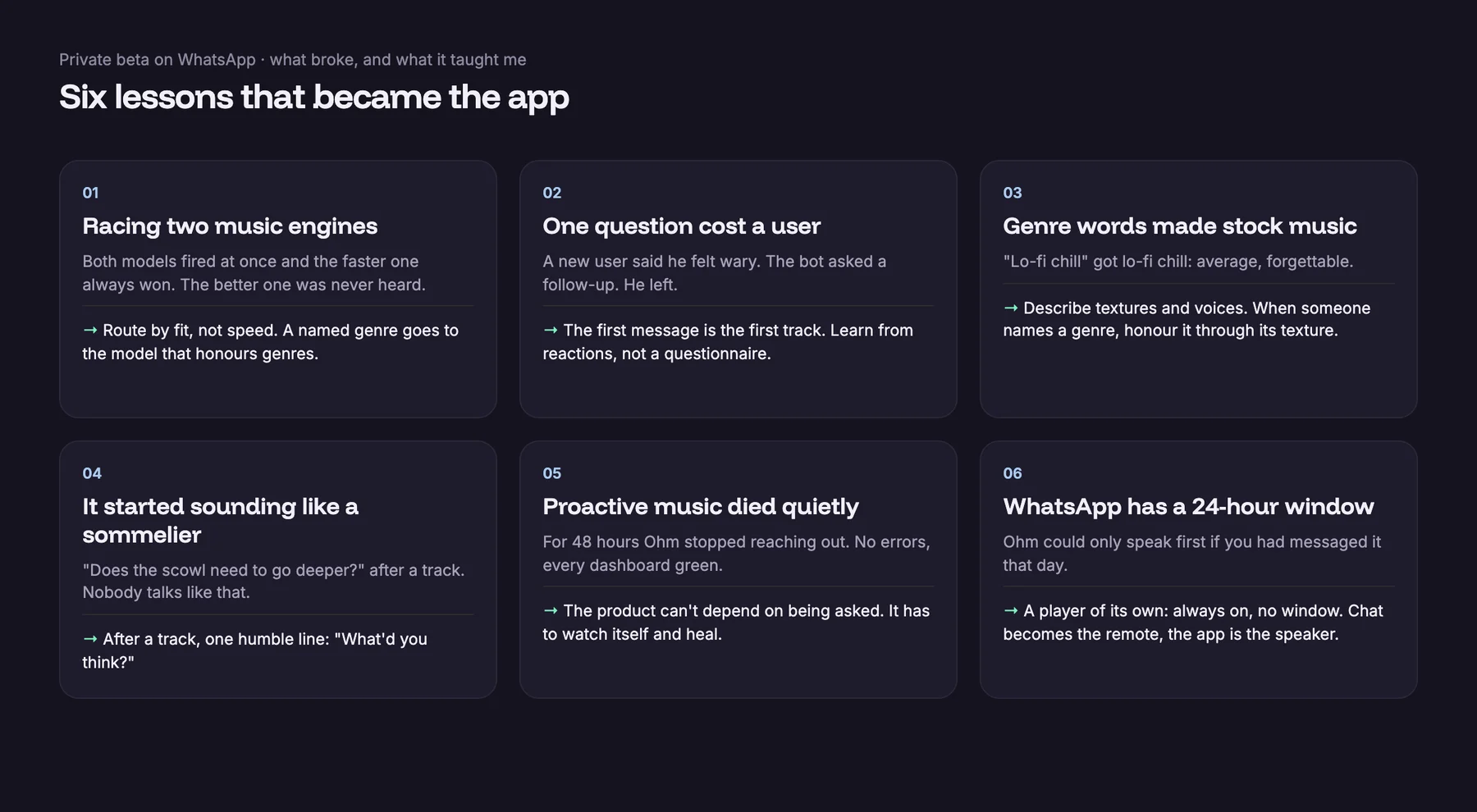
In the beta, a single onboarding question made a new user leave. Behaviour is a better signal than answers anyway.
What it cost: slower learning in week one. The first line carries a lot of weight, so the first track is composed from it straight away.
How do you make a brand you can hear?
Models can't repeat a melody exactly, so the motif is written as notes and played through instruments from your taste: oud for one person, kalimba or piano for another. Same notes, a thousand voices. You can hear it in the first demo: five notes on kalimba, mbira, nylon guitar, Wurlitzer and piano.
What it cost: a separate audio pipeline next to the models. Worth it: recognition comes from the notes, belonging from the voice.
Ship the cheapest surface first
Before designing an app, I needed to know if anyone wanted this, and what would break. So the first Ohm had no app at all. It was a WhatsApp number: you text it your moment, it composes a track and sends it back.
Two listeners used it daily. They pasted conversations back to me as bug reports, and every one taught me something about the product, not just the code.
An app that never asks
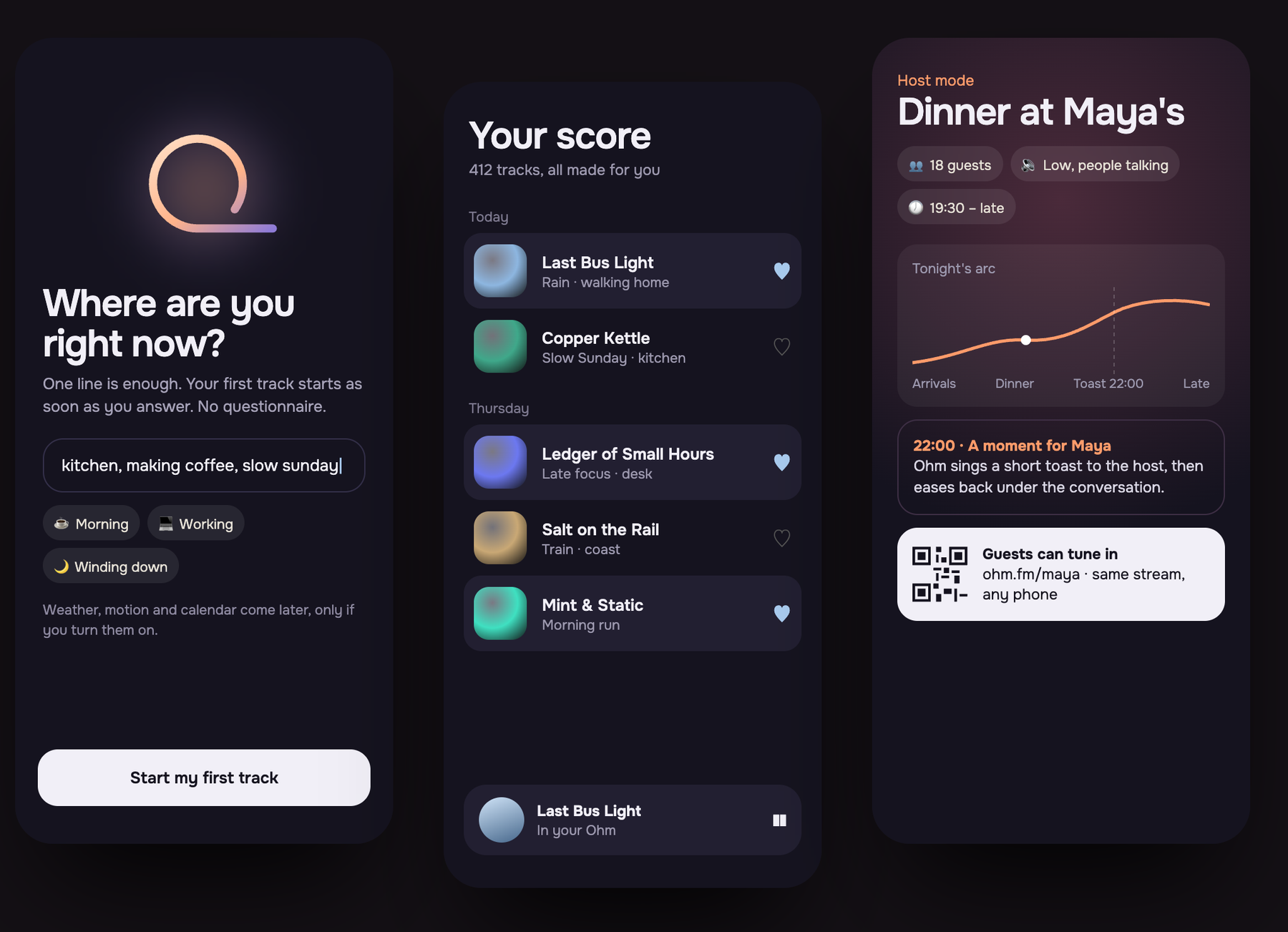
The standalone app keeps the best part of the beta, no menus between you and music, and drops its limits. There's no prompt box on the home screen. Context does the work, and you steer when you want to.
Onboarding is one line and then the first track. Every track Ohm ever made for you lives in your score. And when you're hosting, Ohm runs the whole evening and your guests can tune in from their own phones.
A brand that changes with you
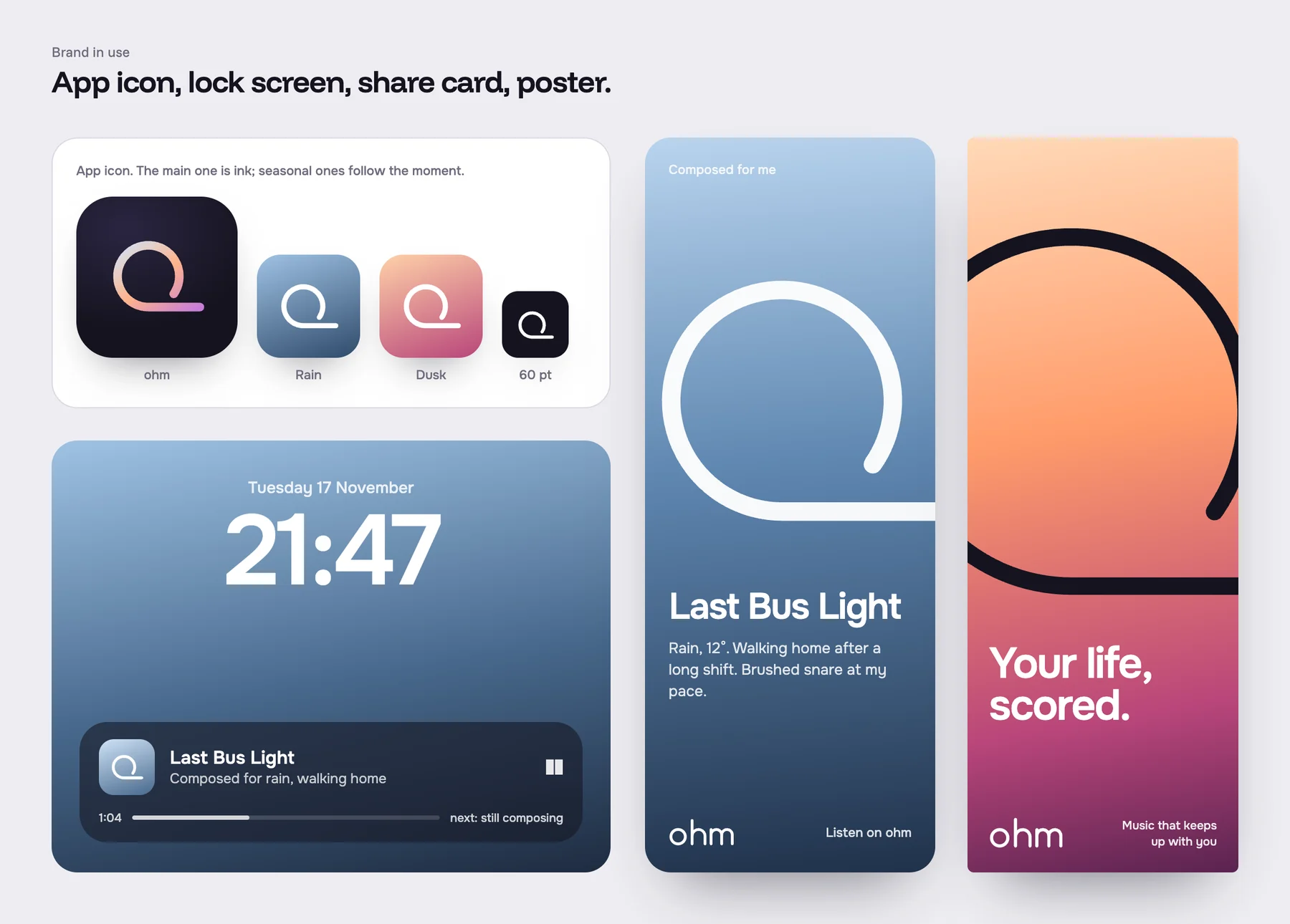
Ohm never stops playing, so the symbol is a line that never closes: it curls around your day and keeps going, like the next track. The wordmark is drawn with the same single stroke, so the name and the symbol look like one hand made them.
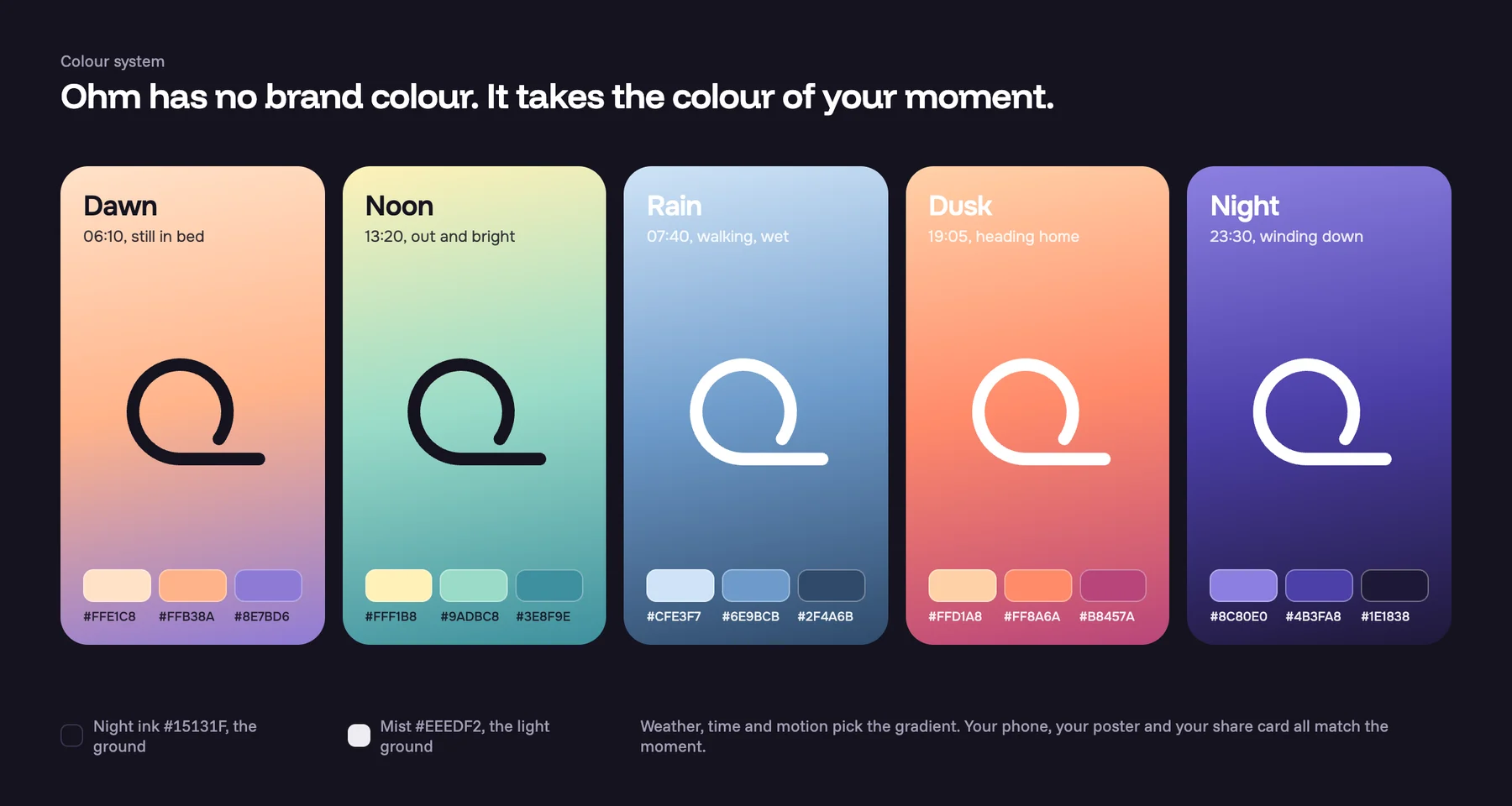
There is no fixed brand colour. Weather, time and motion choose a gradient, so the app, the lock screen, a shared track and even a poster carry the colour of the moment the music was made for. A rainy walk home is blue. Dinner with friends is dusk. Both demos at the top of this page run on these five moments.
Where it is now
The beta is live and composing for its listeners every day. Next is the player: the app's always-on stream, which removes WhatsApp's 24-hour limit and turns chat into the remote control. After that comes the idea this started from: artists publishing songs that Ohm performs for each listener.
The lesson I'd bring to any team: in AI products the model is rarely the moat. Taste is. And taste can be designed, written down and tested like any other part of a product.